
Materials & species guide
Every species has a temper.
A plain guide to the hardwoods, slabs, finishes and resins most commissions come down to: how they look, how hard they are, and how they change once they live in your room.
- Species
- Hardness
- Movement
- Finishes
- Slabs & resin
01 — Species
Six hardwoods, side by side.
Hardness is the Janka rating in pounds-force: the force needed to press a steel ball halfway into the wood. Higher means fewer dents.
-
01
Black walnut
Juglans nigra
1,010 lbfJanka hardness
- Colour
- Chocolate to purple-brown heartwood; pale cream sapwood that can be kept as a feature.
- Grain
- Mostly straight, sometimes wavy or curly; medium texture.
- How it ages
- Lightens and warms toward golden brown with years of light.
- Best for
- Dining and live-edge tables, river tables, chairs.
-
02
White oak
Quercus alba
1,360 lbfJanka hardness
- Colour
- Light to mid tan with an olive cast; takes stains and fuming well.
- Grain
- Straight and open; quartersawn boards show silver ray fleck.
- How it ages
- Ambers slowly; very stable when quartersawn.
- Best for
- Chairs, dining tables, bar tops, commercial work.
-
03
Hard maple
Acer saccharum
1,450 lbfJanka hardness
- Colour
- Near-white to cream, sometimes with figure (curly or birdseye).
- Grain
- Fine, closed and even.
- How it ages
- Yellows gently, more so under oil-based finishes.
- Best for
- Hard-wearing tops, chairs, restaurant tables.
-
04
Black cherry
Prunus serotina
950 lbfJanka hardness
- Colour
- Pale pink-brown when freshly cut.
- Grain
- Fine and straight, with a satiny lustre.
- How it ages
- Darkens markedly to deep red-brown within months of daylight.
- Best for
- Dining tables and chairs for people who like a piece that changes.
-
05
White ash
Fraxinus americana
1,320 lbfJanka hardness
- Colour
- Light cream to pale brown.
- Grain
- Bold, open and straight, similar in figure to oak.
- How it ages
- Ambers slightly over time.
- Best for
- Chairs and bent parts, where its toughness and shock resistance count.
-
06
Cottonwood
Populus deltoides
430 lbfJanka hardness
- Colour
- Pale grey-white to light brown; slabs are often dramatically figured.
- Grain
- Straight to interlocked, fuzzy when cut.
- How it ages
- Soft: dents easily, so it relies on its finish or a resin coat.
- Best for
- Statement slabs and low-wear pieces, not chairs or busy dining tops.
Janka values are standard published averages; individual boards vary.
02 — Movement
Wood keeps breathing after it’s a table.
Wood takes on and gives up moisture with the air around it, and it moves mostly across its width, hardly at all along its length. Denver’s air is dry for much of the year, and heated homes in winter are drier still.
So stock is dried for the climate it will live in, and every solid top is attached in a way that lets it move. That is the difference between a table that stays flat and one that cracks its first January.
03 — Finishes
The finish decides how a piece lives.
No finish is best at everything. The trade-off is usually between hardness and how easily a surface can be repaired.
| Finish | Look | Protection | Repair | Suits |
|---|---|---|---|---|
| Hard-wax oil | Matte, close to raw wood | Moderate; water-resistant when maintained | Easy spot repair, re-oil in place | Home dining tables, chairs |
| Oil-varnish blend | Satin, warm | Good | Can be re-coated | Occasional tables, casework |
| Conversion / catalysed | Any sheen, even and clear | High: heat, water and chemicals | Harder to spot-repair | Bar tops, restaurant and office tables |
| Epoxy flood coat | Deep gloss, or satin when topcoated | Hard, waterproof; softens with heat | Can be re-polished | River channels, slab fills, bar tops |
04 — Choosing a slab
What to look at before you fall in love.
- Dryness
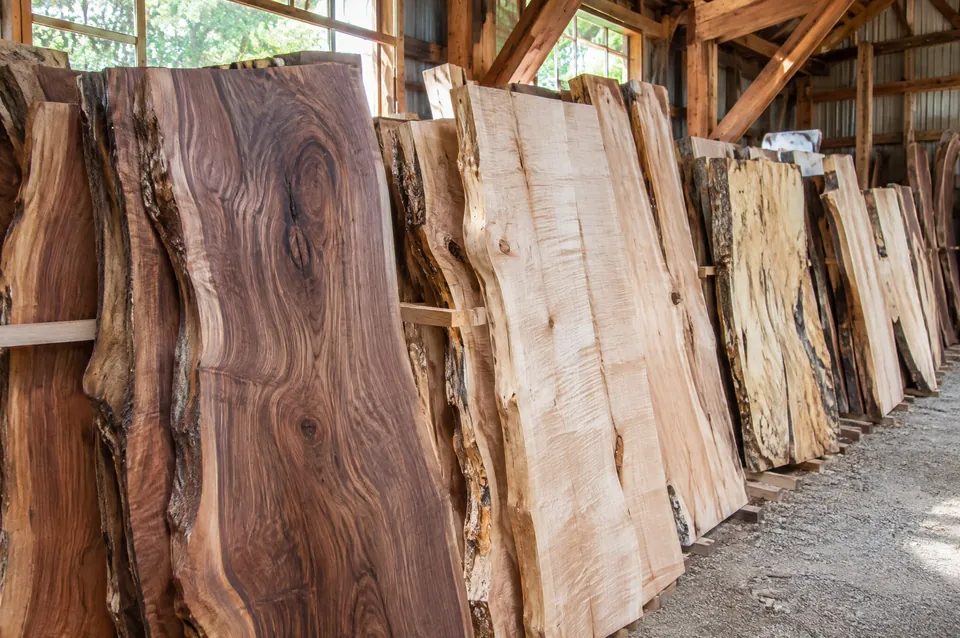
- A thick slab dries slowly. Its moisture content is checked before it is flattened, not assumed.
- Checks & cracks
- End checks and splits are normal. They are stabilised with butterfly keys or resin, or cut away.
- Sapwood & bark
- Bark is removed; whether to keep the pale sapwood edge is a design choice.
- Flatness
- Most slabs arrive cupped or twisted. Flattening costs thickness, so start thicker than the finished top.
- Figure
- Crotches, burls and spalting are beautiful and less stable. They are worth it on the right piece.
Not sure which species?
Choose “No preference” on the form. We will recommend one for your room and use.
Start a commission